
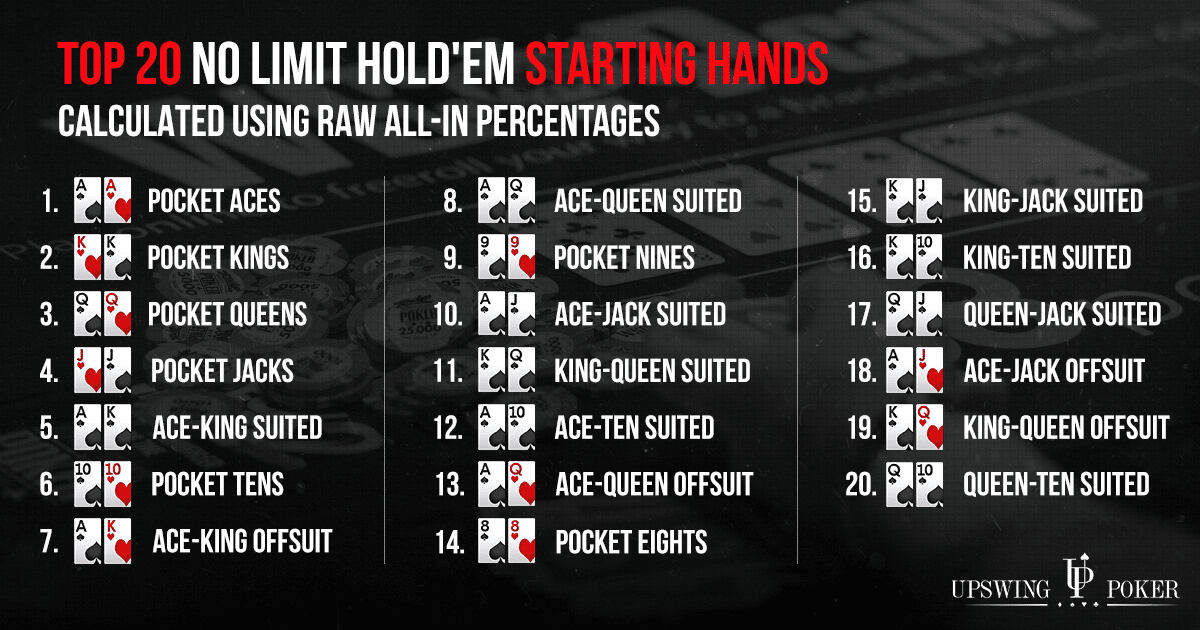
Texas Holdem Heads-Up Preflop Odds. This table was created by enumerating through every possible board and opponent hole card combination for each of the 169 texas holdem preflop starting hands. What hands are rank highest in Poker. ABOUT CARDPLAYER, THE POKER AUTHORITY CardPlayer.com is the world's oldest and most well respected poker magazine and online poker guide.Since 1988. As you have enlightened your knowledge about how to play Texas Hold’em poker, the five-card combination is determined to be the best based on the hand ranking.To fathom the hand ranking better we have fabricated a few frequently asked questions (FAQ) from which you can understand the hand ranking with live game scenarios. Poker Hand Rank. Here is the standard hand rank, from highest to lowest: A royal flush is a hand where all the cards are of the same suit and the 5 highest cards in consecutive order (10, J, Q, K, A). This hand is the best hand that you can get in the game of Texas Hold’em. The hands are ranked from #1 to #169, where #1 is the best. This ranking is applicable when the poker table is full ring (9-10 people). The ranking is based on computer calculation results with all the players staying to the river card. It is not applicable to any real play.
In this lesson you’re going to learn the first and most important step about how to play poker by learning the all important poker hand rankings.
- A standard poker hand consists of five cards.
- Each poker hand is ranked in a set order.
- The higher the rank, the less chance statistically you have of getting it.
- The higher the rank of your hand the better, because two pairs always beats one pair, and a flush always beats a straight.
- When two or more players have a hand of the same rank, then there are more ways to determine the best hand.
Hopefully all these points will make perfect sense by the end of this lesson.
Poker Hands (from Best to Worst)
Be sure to pay close attention and memorize the poker hand rankings. Let’s start with the best possible hand in poker….
Royal Flush
A Royal flush consists of five cards of the same suit, in sequence from 10 through to Ace. Remember that all suits are equal in poker. If two or more players hold a royal flush (highly unlikely) then the pot is split, i.e. the players share the winnings.
Straight Flush
Five cards of the same suit, in sequence. This example shows a Jack high straight flush. If two or more players hold a straight flush then it is the highest that wins. For example, a Queen high straight flush beats a Jack high straight flush. You will notice that this is very similar to a Royal flush, and that’s because a Royal flush is in fact an ace high straight flush – but it’s given its very own ranking.

Four of a Kind
This hand contains four cards of the same rank/value. This example shows four 8’s, plus a 5 (remember that all poker hands must have five cards). If two or more players have four of a kind, then the highest value wins (e.g. four 9’s beats four 8’s). If two or more players share the same four of a kind, which can happen when using community cards (more on that later) then the winner is decided by the fifth card. So a player with four 8’s and a 6 would beat a player with four 8’s and a 5.
Full House
A full house contains three cards of the same rank, plus a pair. In our example you can see three 10’s and a pair of 7’s. The value of the three matching cards determines the strength of a full house. So three Jack’s with a pair of 7’s would beat our example hand. If players share the same three cards, which is possible when using community cards, the strength of the pair is then taken into account. So, three 10’s and a pair of 8’s would beat our example hand.
Flush
Five cards of the same suit in any order. Our example shows a Queen high flush. If two or more players have a flush then the player with the highest ranked card wins. If the players share the same high card then it’s determined by the value of the 2nd, 3rd, 4th, and 5th card respectively.
Straight
This hand contains five unsuited cards in sequence. Our example shows a King high straight. In the event of a tie, the best straight is determined by the highest ranked card. A straight consisting of 8, 9, 10, J, Q, would lose to our example hand. But a straight consisting of 10, J, Q, K, A, would win. Also note that an Ace can be used as the low card for a straight of A, 2, 3, 4, 5. This would lose to a straight of 2, 3, 4, 5, 6.
Three of a Kind
Three cards of the same rank, and two unrelated cards. Our example shows three 4’s. Three 5’s would beat our example hand, three 6’s would beat three 5’s, and so on. If players share the same three cards, then the value of the highest unrelated card would count and if necessary, the value of the second unrelated card. So, three 4’s with Jack, 8, would beat our example hand. As would three 4’s and 10, 9 (because 9 is higher than 8).
Two Pair
Two cards of matching rank, with another two cards of another rank, plus an additional card. In the event of a tie, the highest pair wins. If players share the same highest pair, then the value of the next pair wins. For example, a pair of Aces, and a pair of 6’s would beat our example hand, as would a pair of Kings and a pair of 7’s. If two or more players share the same two pair, then the value of the fifth card counts. So, a pair of Kings, a pair of 6’s, with a 4, would beat our example hand.
One Pair
A paired hand contains two cards of matching rank, plus three additional cards. The value of the pair determines who wins in the event of a tie. For example a pair of 10’s beats our example hand. If players share the same pair then the best hand is determined by the value of the highest additional card. If this is the same then it goes to the second card, and if necessary the third. So, a pair of 9’s with an Ace, 2, and 10, would beat our example hand. As would a pair of 9’s, King, 10, and a 3.
High Card
If a hand doesn’t fall into any of the above categories, then it is judged on the value of the highest ranked card among the five. In this example we have a hand which is Queen high. If players share the same highest card, then it goes to the value of the 2nd, 3rd, 4th, and even 5th card if necessary. A hand of Queen, 10, 9, 5, 4, would beat our example hand.
Community Cards
No Limit Hold'em Starting Hand Rankings
As you already know, a poker hand consists of five cards. In many variations of poker, players receive or can choose from more than five cards. For example, in Texas Hold’em each player is dealt two private cards, but can also use the five community cards that are available for all the players to use. This makes a total of seven cards, but each player must choose their best five cards to make their best possible hand. Here’s an example:
In the above example, the best five cards among total of seven (two private cards and five community cards) would be combined to make a flush.
Once you have the basic rules of poker understood, it’s time to start building a powerful strategy. See how our friends at Red Chip Poker built the perfect course to give you the perfect playbook…
Conclusion
If you don’t fully understand the poker hand rankings then please read through the list again. It’s vital that you know which hand beats which. Of course, how good a poker hand is, is very dependent on which type of poker game you are playing and other factors such as the number of other players you are playing against. You will learn the true strength of a poker hand as you gain experience of playing the game.
We have created a printable poker hand rankings chart that you can use as a source of reference. Hopefully we’ve explained the poker hand rankings to you well enough whereby you don’t need this chart, but it still might be handy for some. The chart will load as a PDF (link opens in a new window) and you’ll need to have Adobe Acrobat installed on your computer to be able to view it.
Make sure that you memorize the poker hand rankings before moving onto the next lesson.
Related Lessons
By Tim Ryerson
Tim is from London, England and has been playing poker since the late 1990’s. He is the ‘Editor-in-Chief’ at Pokerology.com and is responsible for all the content on the website.
Nl Holdem Hand Rankings Drills
Related Lessons
Related Lessons

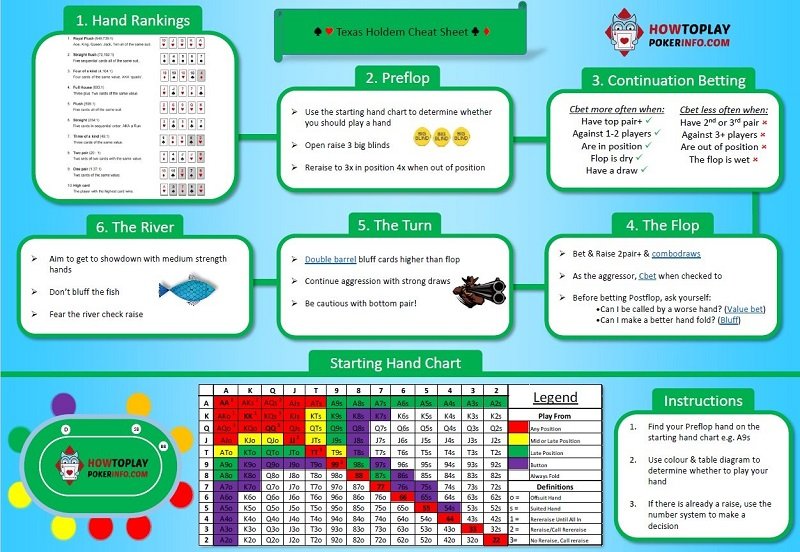
NL Hold’em Starting Hand Charts
One aspect of the game of No-Limit Hold’em that causes beginning players much grief is deciding which hands to play and which hands to dump. NL Hold’em is much more difficult than Limit Hold’em because the value of a hand depends on so many factors other than just the cards in your hand. Despite this difficulty, our coaches believe that following some general guidelines and adjusting from these is a better solution than having no guidelines at all. Given that well over half of your profitability in NL Hold’em is based on hand selection alone, we have developed these charts to help you better determine whether to play or fold.
There are no perfect No-Limit starting hand charts. That is because there are many factors that affect your decision, and charts cannot account for all of them. Some of these include:
- The size of your opponent's stacks.
- How loose or tight, passive or aggressive, your opponents are.
- Where these opponents are located at the table – for example, does an aggressive player still have to act after you?
- Your image at the table – for example, how tight or tricky you are perceived.
That being said, these charts will serve you well in most typical low-stakes No-Limit cash games, such as games with blinds of $1/$2, and home games. These games typically have several loose players at the table, and good opportunities for winning big pots with suited connectors and pocket pairs. With practice, you will be able to be a consistently winning player with these charts as a starting point. As you improve, you'll find yourself making adjustments to these charts based on the factors listed above, and more.
AGAIN: These charts are a good starting point for beginners. Specifically, Chart #1 recommends a significant amount of limping. This is great in loose, passive games but less often seen in tougher games. You’ll find other training material on Advanced Poker Training that may recommend a more aggressive approach for more experienced players.
Note: It would be a serious mistake to apply these hand charts before reading the Frequent Asked Questions first.
CHART #1 ‐ LOOSE, PASSIVE GAME (OFTEN 4-5 LIMPERS PER HAND)
NO ONE HAS RAISED YET

- Raise Always
- Call from Early Position, otherwise raise
- Call always
- Call from Middle or Late Position if the conditions are right (see Frequently Asked Questions)
No Limit Texas Holdem Hand Rankings
CHART #2 ‐ TIGHTER GAME (FEWER LIMPERS) OR MORE AGGRESSIVE GAME
NO ONE HAS RAISED YET
- Raise Always
- Call from Early Position, otherwise raise
- Call (or Raise) from Middle or Late Position if the conditions are right (see Frequently Asked Questions)
CHART #3 ‐ THERE HAS BEEN A SINGLE RAISE
(3‐5 TIMES THE BIG BLIND) BEFORE YOU
- Re‐Raise Always
- Call from Early Position, otherwise re‐raise
- Call always
- Call from Middle or Late Position if the conditions are right (see Frequently Asked Questions)
FREQUENTLY ASKED QUESTIONS
Nl Holdem Hand Rankings College Basketball
For the hands in yellow, what do you mean when you say to play these hands if the conditions are right? The hands in yellow are speculative hands. They should always be folded from Early Position. From other positions, they can be profitable given the right conditions. Some of the questions to ask yourself:
- Are there other players who have called so far (the more, the better)?
- Are the players who have called playing poorly after the flop? Will they pay me off if I hit something?
- Is there an aggressive player still to act behind me (you might get raised and have to fold)?
- If there has been a raise and no other callers, what chance do I have of using my position after the flop to win the hand even if I don't improve (Chart #3 only)?
Why does Chart #2 say to sometimes raise with the hands in yellow, but Chart #1 does not? We have different goals in mind. Using Chart #1, we want to call to encourage additional players to enter the pot. These hands will be immensely profitable when our loose, passive opponents enter the hand, and get trapped when we flop a set, or make a well-disguised straight. When using Chart #2, however, we want to size up the opponents still to act. If they are tight, we can raise. Sometimes, we'll pick up the blinds. Other times, our pre-flop aggression will allow us to take down the pot on the flop.
What's the difference between AKs and AKo? AKs means an Ace and King of the same suit. AKo means an Ace and King of different suits.
What are early, middle, and late position? Early Position is generally the first 2 (in a nine player game) or 3 (in a ten player game) positions after the blinds. Late Position is the “cutoff” position (to the right of the dealer), and dealer button positions. Middle Position is everything in between.
How much should I raise? As a general rule, raise 3 to 4 times the big blind, plus 1 extra big blind for every player who has called before you. So if there are 2 callers already, raise between 5 and 6 times the big blind.
What if someone raises after I call? Whether you call the raise depends on how much money the raiser has for you to win, how many other players are involved, and what type of hand you have. As a general rule, if you have a pocket pair, lean towards calling. If there are a lot of other players (and therefore a big pot), lean towards calling. In general, fold suited connectors from early position. Fold hands like KQ that don't play well against a raiser.
How do I play from the blinds? From the small blind, play the same hands you would play from late position, plus a few more. But don't call with junk hands like T5o, just because it is “cheap”. From the big blind, if there is a raise to you, play like you would if you had already called from early position.
The chart says to fold KQo to a raise. Really? Yes, this hand performs very poorly against typical raising hands. Against AK, AQ, AA, KK, QQ, you are a big underdog. Other typical raising hands like JJ, TT, 99, AJs, are slightly ahead of you as well. The only time you might call or re-raise is from late position, if the opener was in middle or late position, indicating they might have a wider range of hands.
I was told to fold AJo from Early Position, why do you say to call with it? Folding AJo is not a bad idea in many games. We included it because, at low stakes tables (even tight or aggressive ones), the players are often playing badly enough after the flop that it can be profitable. We used data from millions of hands of low-limit poker to analyze this. The same could be said for KQo, ATs, and KJs – you can make a small profit in the long run at most low-stakes games, but folding would be perfectly acceptable from early position.
Can I use these charts in a NL Hold'em tournament? The charts would be best applicable to the early stages of a NL tournament, when everyone has a deep stack. In the middle and later stages, they should not be used.
Nl Holdem Hand Rankings Cheat
Read all our instructional articles
No Limit Hold'em Hand Rankings