
Check-raise is permitted in all games, except in certain forms of lowball.
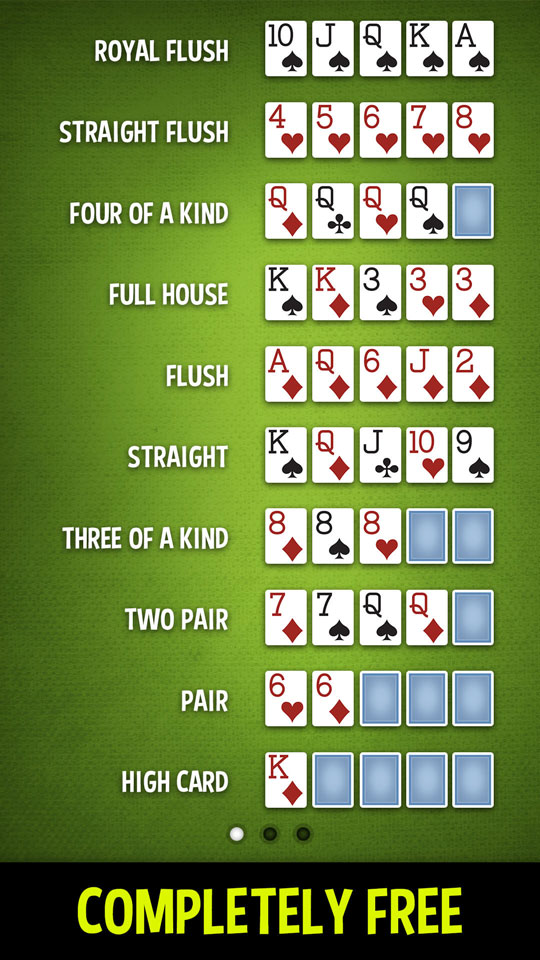
Poker Hand Combinations Explained. Poker hands fall into one of ten categories. The highest is a royal flush, followed by a straight flush, then four of a kind, a full house, a flush, a straight. The is the best possible hand you can get in standard five-card Poker is called a royal flush. This hand consists of an: ace, king, queen, jack and 10, all of the same suit. If you have a royal flush, you'll want to bet higher because this is a hard hand to beat. Liliboas / Getty Images. Five card draw is one of the most common types of poker hands. Each player is dealt five cards, then a round of betting follows. Then each player may discard up to 3 cards (4 if your last card is an ace or wild card, in some circles) and get back (from the deck) as many cards as he/she discarded.
In no-limit and pot-limit games, unlimited raising is allowed.
- In poker games, suits (spades, hearts, diamonds and clubs) are all considered equal, so there is not ranking of the suits. If two people both have a flush, the winning hand is determined by the highest card. If two players both have two pair, the player with the highest pair wins.
- The Value of Poker Hands One element used in most poker variants is the system of hand rankings. The highest ranked hand is a Royal Flush (five cards of the same suit, ranked ace through ten).
Unlimited raising is allowed in heads-up play. This applies any time the action becomes heads-up before the raising has been capped. Once the raising is capped on a betting round, it cannot be uncapped by a subsequent fold that leaves two players heads-up.
Any wager must be at least the size of the previous bet or raise in that round, unless a player is going all-in.
If someone is 'all in', how much of the pot can they win? A person who is all in can win the amount of the pot that they have invested. Any additional bet starts a new 'side pot' and can only be won by players contributing to that pot.
The smallest chip that may be wagered in a game is the smallest chip used in the antes, blinds, rake, or collection.
A verbal statement denotes your action and is binding.
Rapping the table with your hand is considered a pass.
Deliberately acting out of turn will not be tolerated. A player who checks out of turn may not bet or raise on the next turn.
To retain the right to act, a player must stop the action by calling 'time'. Failure to do so may cause you to lose the right to act. You can’t forfeit your right to act if any player in front of you has not acted, only if you fail to act when it legally becomes your turn. A player who bets or calls by releasing chips into the pot is bound by that action.
In limit poker, if you make a forward motion with chips and thus cause another player to act, you may be forced to complete your action.
To protect your right to raise, you should either declare your intention verbally or place the proper amount of chips into the pot.
If you put a single chip in the pot that is larger than the bet, but do not announce a raise, you are assumed to have only called so make sure you know what you are putting in the pot.
All wagers and calls of an improperly low amount must be brought up to proper size if the error is discovered before the betting round has been completed. In poker you must be alert and fully aware of what you are doing at all times.
For those unfamiliar with poker rules and the game of Poker, along with others who might want a refresher, this is the most basic of basic poker. The various games are based on this.
/royal-flush-172214648-bafb6213188744e981412665b63b6be2.jpg "Poker")
Poker is a game of five card hands dealt from a 52 card deck of standard playing cards. All poker hands consist of exactly five cards. Most games, like seven card stud for example, give the players more than five cards to select from, but the final winning result goes to the one with the best five card poker hand. In the popular stud poker games, the players are all dealt one card at a time or in small groups and they bet money each time they get more cards. They bet that they will end up with the best hand. The players that don't want to bet on their hands any longer can 'fold' their hands, get out of the contest and forfeit all the bets they have made to that point. At the end, the player with the best poker hand wins all the bets. In draw poker the players bet, then replace the cards they don't like with new ones from the dealer and then bet again.
The best hand is determined by the Poker Hand Ranking chart below.
Mobile Users - I've created a special chart in universal .pdf format for easy viewing on narrow screens. The original large chart is also available for downloading, viewing or printing.
Mobile - hand-rankings-mobile.pdf
Tablet / Desktop - hand-rankings.pdf
Rules for the More Popular Poker Games
Basic Poker Resources
- Poker Terms - Before sitting down at a poker table, new players should check out my glossary and get familiar with some of the poker lingo.

Can you name thesePoker Legends?
Basic Hands Of Poker Card Game
In 1978, Doyle Brunson, two time winner of the 'World Championship of Poker' at Binions Horseshoe in Las Vegas, published probably the best ever written book on casino level poker games. This 600 page, 3 lb. volume is more like an encyclopedia reference than a typical poker book. The work is packed with sound professional advice with volumes of stats for advanced players and was strangely named 'How I Made Over $1,000,000 Playing Poker'. In reprint, it is now named 'Super System'.
Basic Hands Of Poker Rules
For this classic, Brunson enlisted the services of some of the best professional poker players in the world, all champions in their own right, to collaborate the authoring of the game sections of their particular specialties. The cartoon of this world class poker game is shown on the books inside front cover. Here are the players and their game contributions.
Basic Poker Hands
1. DOYLE BRUNSON - No Limit Hold'em 2. MIKE CARO - Draw Poker 3. JOEY HAWTHORN - Five and Seven Card Lowball 4. DAVID SKLANSKY - Seven Card Stud, High-Low Split 5. CHIP REESE - Seven Card Stud 6. BOBBY BALDWIN - Limit Hold'em